Trees are the most valuable plants on any property in Upstate New York. A mature oak in Pittsford or a century old sugar maple in East Aurora adds shade, privacy and real dollars to a home, so we never recommend tree removal lightly. But some trees reach a point where the risk to people, roofs and vehicles outweighs everything the tree gives back. The hard part for most homeowners is telling the difference between a tree that looks rough and a tree that is genuinely dangerous.
This guide walks through the seven warning signs our climbers look for on every estimate across Buffalo, Rochester and Syracuse, what each one means for the tree, and when a sign points to pruning instead of removal. If you recognize two or more of these on the same tree, it is time to have it looked at before the next storm makes the decision for you.
1. A dead or thinning crown
Start at the top. A healthy tree in July should be full of leaves right out to the tips of the branches. A tree that leafs out only on the lower limbs, or one where whole sections of the crown stay bare while the rest of the neighborhood is green, is in decline. Tree crews talk about crown dieback as a percentage. Once more than a third of the crown is dead, recovery is unlikely, and once it passes half, the tree becomes brittle, unpredictable and dangerous to climb.
Thinning happens for many reasons: root damage from construction or a new driveway, years of drought stress, girdling roots wrapped around the trunk, or disease. Sometimes the cause can be corrected and a tree with modest dieback can be pruned back to sound wood and given a few seasons to recover. That is a conversation worth having on site rather than guessing from the sidewalk.
2. Fungus, mushrooms or shelf conks at the base
Mushrooms in the lawn are usually harmless. Mushrooms or hard shelf fungi growing directly out of the trunk, the root flare or the large surface roots are a different story. Those fruiting bodies are only the visible part of a fungus that has been digesting the wood inside the tree for years. The outer sapwood can look perfectly sound while the heartwood that actually holds the tree up has turned to something closer to cork.
We see this constantly on the big silver maples of Cheektowaga and Irondequoit. The tree looks fine, the leaves are full, and then a routine wind event drops the whole thing because the base was hollow. If you see conks, have the tree assessed. A resistance drill or a sounding mallet tells us how much solid wood is left, and that number, not the leaf count, decides whether the tree stays.
3. A new or worsening lean
Plenty of healthy trees lean. They grew toward the light, or away from a building, and they have been leaning the same way for fifty years. The lean that matters is the one that changed. Watch for soil heaving or cracking on the side away from the lean, exposed roots lifting on one side, or a gap opening in the ground at the base. Those signs mean the root plate is failing and the tree is slowly tipping over.
A tree with a failing root plate cannot be pruned back to safety. It needs to come down, and the sooner the better, because a tree that has started to move will finish moving in the next ice storm. Lake effect events off Lake Erie and Lake Ontario are especially good at finishing the job, which is why our emergency storm damage crews are busiest the morning after a big wind.
4. Cracks, cavities and included bark
Look at the trunk and the major forks. Deep vertical cracks in the trunk, large cavities where a limb was lost years ago, and forks where two trunks meet in a tight V with bark pinched between them are all structural weaknesses. That tight V, called included bark, is the classic failure point on silver maples, Bradford pears and many Norway maples. There is no wood holding the two halves together, just bark, and every ice storm pries at it.
This is the one category where removal is often not the answer. A tree with a weak fork but a sound trunk and a healthy crown can often be kept. Our trimming and pruning crews take weight off each side of the fork so it carries less load in wind and ice. That costs far less than removal and it keeps the tree. The deciding factors are the size of the crack, how much decay is behind it and what the tree would hit if it failed.
5. Emerald ash borer damage
If you own an ash tree anywhere in Western or Central New York, it has almost certainly been attacked. The emerald ash borer arrived in the region more than a decade ago and has killed the vast majority of untreated ash trees. Look for a thinning crown, D shaped exit holes about an eighth of an inch across, S shaped tunnels under peeling bark, heavy woodpecker activity, and sprouts shooting from the base of the trunk. The national emerald ash borer information network has good photos of each sign.
Dead ash is a special problem because the wood becomes brittle unusually fast. Within two years of dying, an ash can be too dangerous to climb, which means a crane or a bucket truck instead of a climber, and a higher price. If your ash is showing symptoms, the cheapest removal is the one you schedule this year. Treatment with a systemic insecticide can save a healthy ash that is not yet heavily infested, but it is a commitment every two years for the life of the tree.
6. Storm damage that changed the structure
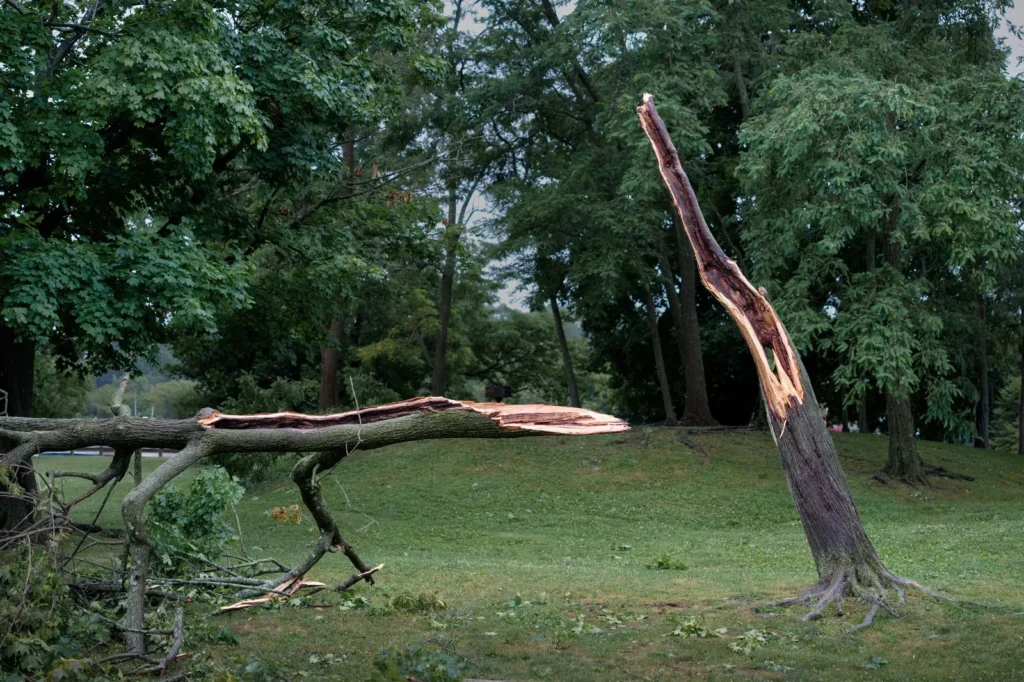
A tree that has lost a major limb, especially one that took a strip of trunk bark with it, or a tree that has lost its top, rarely regains a sound structure. The wound is too large to seal before decay sets in, and the remaining limbs were never meant to carry the wind load alone. Some trees can be restored with careful reduction pruning over several seasons, but a tree that has lost more than a quarter of its crown to breakage is usually a removal.
After a storm, resist the urge to clean up the tree yourself. Hanging limbs, called widow makers for a reason, can drop without warning, and a trunk under tension can split violently when cut. Our 24/7 storm response crews stabilize the tree first, then remove it in sections, and we document everything for your insurance claim.
7. The right tree in the wrong place
Sometimes the tree is perfectly healthy and still needs to go. Roots lifting the foundation, a canopy that has swallowed the service line, a spruce planted four feet from the house forty years ago, or a maple that shades the only spot in the yard where a garden could grow. In new subdivisions across Wheatfield, Farmington and Clay we see fast growing trees that builders planted too close to the house, and by year fifteen they are a problem.
Removal in these cases is a landscape decision, not an emergency, and it usually pairs well with stump grinding and replanting a better suited species a little farther from the house. If you are planning a larger project, an addition, a pool or a new driveway, that is the time to think about which trees stay, and our land and lot clearing crews can handle several at once.
What it costs to wait
The most expensive removal is the one that happens after the tree fails. A planned removal of a large maple in an open yard is a few hours of work with a climber and a chipper. The same tree on a roof at two in the morning after an ice storm needs a crane, a tarping crew and an insurance adjuster, and the cost of the roof repair dwarfs the cost of the tree work. Homeowners insurance often covers removal of a tree that has damaged a covered structure, but it rarely covers removing a tree that is simply dying in the yard.
How we assess a tree
On every estimate we look at the whole tree: the crown, the trunk, the root flare and the ground around it. We look at the target, meaning what the tree would hit if it failed, and we look at the access for our equipment. The warning signs we check are the same ones the International Society of Arboriculture lists for homeowners. Then you get a written estimate with a plain recommendation. Prune it, remove it, or leave it alone and look again next year.
If you recognized any of the signs above on a tree in your yard, call the 24/7 line at (585) 000-0000 or request a free estimate. We serve Buffalo, Rochester, Syracuse and the towns in between, and the estimate is always free.
Need a hand with a tree?
Free estimates across Buffalo, Rochester and Syracuse. Call or send the form.